Prima Verba – Part 12
Shapes and Forms

At this point in my journey (a journey I didn’t even know I was on!) Keith and I had reconnected over lunch, and I had decided to try to gain a better understanding of his Catholic faith.
This wasn’t because I had any interest in the Catholic Church—far from it. No, it was because I felt I owed it to him, as a friend, to understand his world as well as I could. And I knew I needed to understand it as he understood it, not as a critic outside the Catholic Church understood it, wrote about it, or taught about it.
I say that because in my life as a Protestant, and specifically as a Reformed Christian, I encountered many critics of the Catholic Church. I had, in fact, informally adopted a couple of them as my theological mentors, and I had read almost everything they published.
So, to say that I had a bias against Catholicism is to be in contention for the Understatement of the Year award. But I decided to set that bias aside temporarily and see what the Catholic Church taught (and, therefore, what Keith believed) in its own words.
As I said previously, my source for this undertaking was to be the Catechism of the Catholic Church (CCC). And I suppose a word about catechisms in general might be helpful here.
Many Protestant denominations, such as Lutherans and Presbyterians, utilize catechisms. For these non-Catholic churches, having a set of standards alongside the Bible is normal. But there are other Protestant denominations and non-denominational churches for which the very idea of a written authority other than the Scriptures is repugnant. I was in the former group.
My Reformed denomination, in addition to affirming three Creeds (Apostles’, Nicene, and Athanasian), also affirms three Confessions—the Belgic Confession, the Heidelberg Catechism, and the Canons of Dordt.
My point in saying all this is that in reading the CCC, I wasn’t stepping outside my comfort zone in any way, shape, or form. Catechisms and Confessions were already very much a part of my world. I was simply going to read a different catechism as an academic exercise for a relational purpose. No big deal.
But it didn’t take long for me to realize I would need a way to track what I agreed with and what I disagreed with. And this needed to be done without adding excessive time and complexity to the whole endeavor, since the Catechism is quite lengthy. So, I decided to mark each article number to show my agreements, disagreements, as well as my in-betweens and uncertainties.
My method was simple. If I agreed with an article, I would circle its number. If I disagreed, I would draw a triangle around the number. If I wasn’t sure about something in an article, didn’t understand it, or agreed with only part of it, I would draw a rectangle around the number.
And that’s it really. A system of circles, triangles, and rectangles. I went back a few pages, started over, and read every single article of the CCC, marking each one with one of these three shapes.
Here’s an example that shows my thoughts after an initial read and where I ended up sometime later:
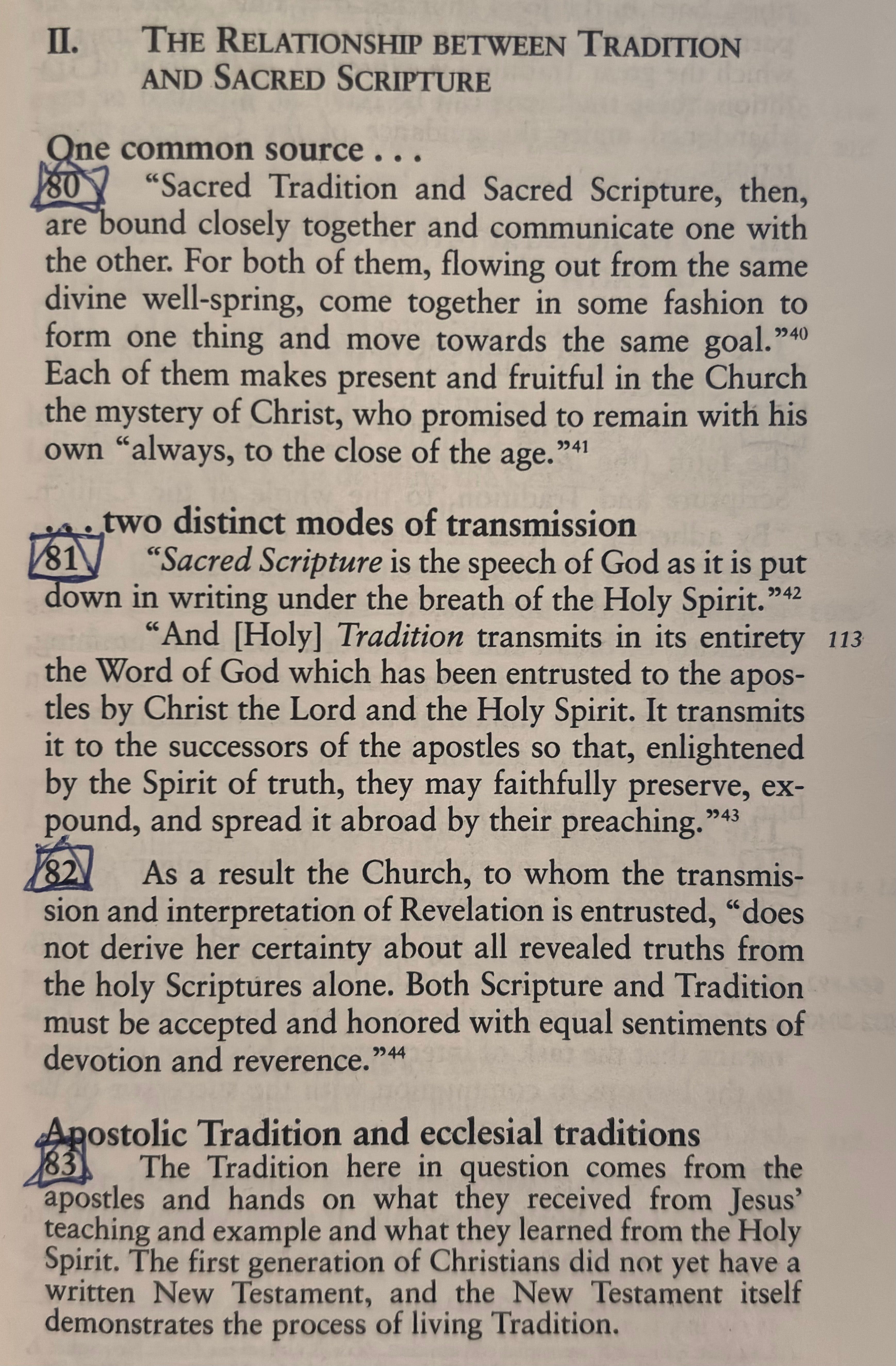
As you can see by the triangles, I was having none of the Catholic Church’s teachings about Sacred Tradition. I was still very entrenched in and committed to sola Scriptura. But as time went on, I would periodically revisit my rectangles and circles, and they occasionally upgraded. That’s what you’re seeing here. Firm disagreements had softened to partial disagreements.
The following is a page from the Catechism that I failed to update each time I revisited it. As you can see, all three marks are present. Below it, I’ll try to reconstruct my thought process as best I can, nearly three years later.
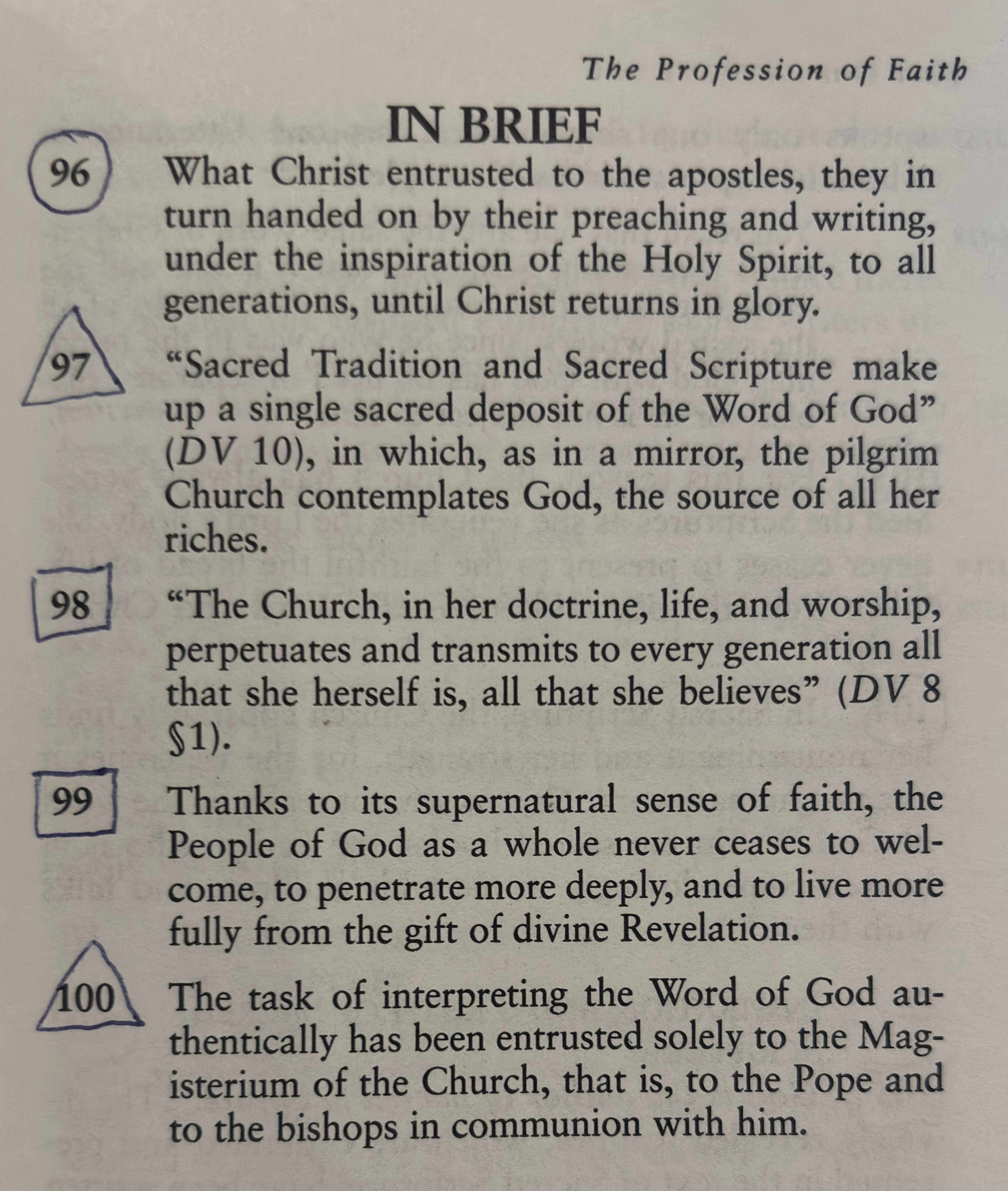
96. I saw nothing objectionable here. The apostles’ writing and preaching were both contained in Scripture.
97. This was a big No. Neither Sacred Tradition nor anything else could exist at the same level of authority as Sacred Scripture.
98. There was a sense in which I could agree with this. I was already very committed not only to the organism that is Christ’s Church but also to the institution of the Church. At the same time, I was reasonably sure that more was being conveyed by the word “transmit” than I could fully agree with.
99. Again, for the most part, I could affirm this article. However, I suspected that Sacred Tradition was understood as being part of divine Revelation, so I marked it as a partial agreement.
100. It comes as no surprise, I’m sure, that I disagreed entirely with this one!
Recalling that Keith and I met for lunch on May 4, 2023, I’m guessing it was late May or early June of that year when I started reading the Catechism for the first time. Eventually, I added another layer to the process by recording the numbers from triangled or rectangled articles in a Word document. Each time I reviewed my disagreements and uncertainties, I would update the Word document to a new version, while retaining all the older versions.
After that first lunch, Keith and I continued to get together fairly regularly—sometimes just the two of us, other times with Estelle and Cami. Eventually, the day came when we met for lunch, and I was officially objection-free. I had printed out each version of the document and brought them into the restaurant in a folder. Now, I had been playing things pretty close to the vest with him for a while at that point, so he didn’t know where I was in my process.
We ordered our meals, and while we waited, I told him I wanted to show him my objections to the Catechism of the Catholic Church. He raised his eyebrows and said, “Okay…”
I set the first version on the table in front of him. It was multiple pages long, and each page had three columns of article numbers from the CCC. I let him react briefly to all those numbers (I have no recollection of what he said, if anything), before saying, “But I went back over all these disagreements, and here’s where I ended up.” And I set the next version in front of him. This one, of course, had fewer numbers on it. I think he was at least mildly encouraged by that.
Anyway, I repeated this process with two or three more versions, until finally I said, “And here’s where I am now. These are my objections to the Catholic Church.” And I laid a blank piece of paper in front of him. As you might imagine, our conversation that day was very different from our previous ones!
But where did this leave me? At my core, I was still a burnt-out pastor, waiting for God to show me a resignation off-ramp and somehow give Cami eyes to see it too, as well as a heart to choose it.
This Aaron/Cami dynamic is where I’ll be turning next. But before I do, I need to say a word or two about how I was processing all these new and surprising agreements with the Catholic Church. That will be the topic of Part 13, and maybe Part 14 as well.
*******
I want to thank you all again for your interest in my story and for your very generous support—both of which mean the world to me! This year hasn’t been easy, but Cami and I have known the Lord’s peace through it all, and you have been a part of how he has shown us that peace. We are grateful.
As this goes live, we are at the end of Advent, and I am praying that you will have a very Merry Christmas and that your New Year will be filled with God’s peace!
May the Lord bless and keep you all.
Gloria in excelsis Deo
Aaron
I’ve enjoyed reading about your journey of faith. I’m a lifelong Lutheran married to a Catholic. My best friend, your cousin Cassie, told me about your Substack. We talk about our two faiths & I’ve debated for years about converting. I think I’ll try going through the CCC as you have & see where I end up. I think Cassie will be thrilled. Wishing you and your family a very Merry Christmas and a blessed New Year!
J in Long Beach